
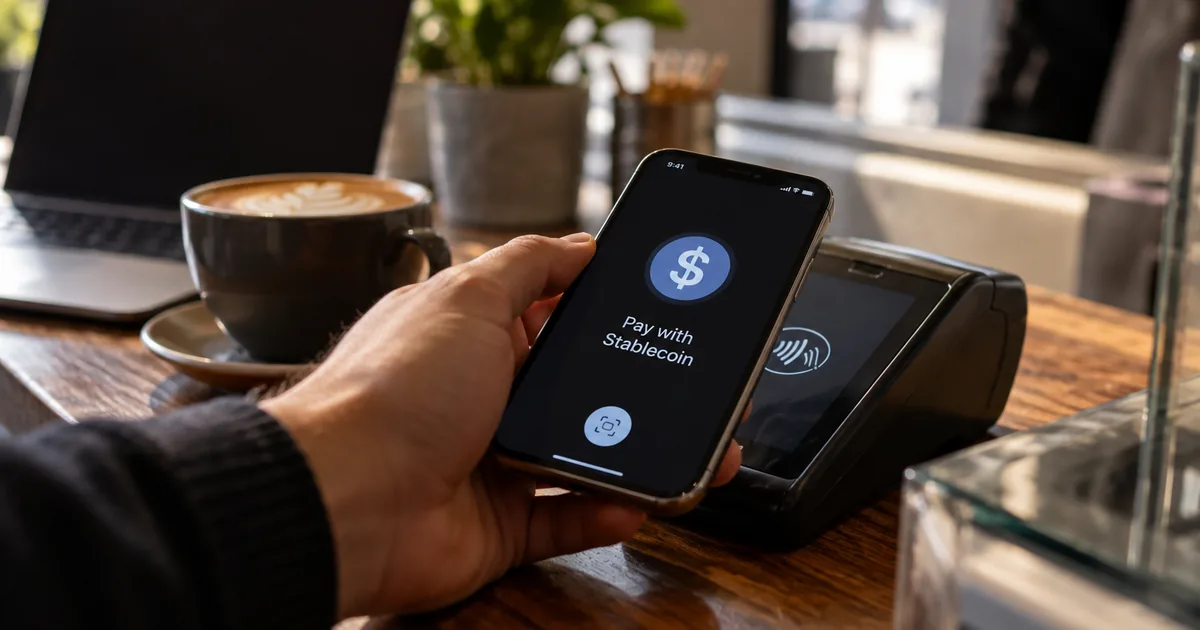
Stablecoins promise faster transfers and fewer settlement delays. Mastercard's newest product shows how those benefits can coexist with another familiar feature of traditional finance: transaction monitoring.
On October 19, Mastercard announced Stablecoin Security, a risk-intelligence service that combines payment data with blockchain analytics to help financial institutions assess stablecoin transactions. Its purpose, Mastercard says, is to identify fraud, scams, sanctions exposure and other financial-crime risks—including before funds move on-chain.
RISK SCORES BEFORE MONEY MOVES
The service uses a platform-agnostic API to analyze transaction context, the origin of funds, exposure to restricted parties and scam indicators. It can produce a risk score before a payment is completed and feed that information into banks' existing fraud, compliance and case-management workflows.
Mastercard illustrates the use case with a Boston coffee shop paying a supplier in Brazil. The bank uses stablecoins for the cross-border transfer, while its service provider evaluates the transaction first. The bank can then decide whether the payment proceeds normally or needs further review.
That distinction matters: Mastercard is selling risk intelligence to financial institutions. Its announcement does not establish that Mastercard itself can freeze every stablecoin, veto every blockchain transaction or surveil all wallets.
THE CASE FOR FRAUD PREVENTION
The business case is substantial. Blockchain transfers can be difficult to reverse, and cross-border payments can involve multiple intermediaries. Mastercard cites a study of 593 million stablecoin transfer events across 141 million Ethereum transactions in 2025; nearly 60% involved complex, multistep flows rather than simple one-to-one transfers.
For institutions handling customer funds, detecting scams and sanctioned counterparties before settlement can reduce harm. A warning that prevents a fraudulent payment is not the same thing as an unjustified restriction on a legitimate customer.
WHERE PRIVACY ENTERS THE PICTURE
The same technology that helps identify suspicious transfers can also reveal more about ordinary financial behavior. Public blockchain activity can already expose addresses, amounts and transaction histories. Combining those records with payment-system intelligence may provide institutions with additional context about who is paying whom and why.
A small business may reasonably want supplier relationships kept confidential. A household may not want every transfer profiled. Neither preference implies wrongdoing. The relevant questions are what data gets collected, how long it is retained, who can access it, and what recourse exists when a transaction is incorrectly flagged.
Mastercard has not disclosed every detail of its scoring methodology or how individual participating institutions will resolve disputed risk assessments. Those are important limits on what can be concluded from the announcement.
BLOCKCHAIN SETTLEMENT IS NOT THE SAME AS PERMISSIONLESS ACCESS
A blockchain can move funds quickly while the bank or payment provider using it still requires identity checks, compliance screening and account-level approval. Some stablecoin issuers also retain powers to restrict certain token movements. These are distinct layers of control, and they should not be confused with the underlying network's settlement mechanics.
The practical test for financial sovereignty is broader than speed: who holds the keys, who can pause access, what information is exposed, and how easily can an innocent customer challenge a mistaken decision? A fast payment can still be a permissioned payment.
MASTERCARD'S EXPANDING STABLECOIN NETWORK
Borderless.xyz and Keyrails are initial partners. Mastercard says Borderless.xyz connects institutions with licensed stablecoin providers in more than 113 countries and 72 currencies; Keyrails works on high-value cross-border trade payments. Mastercard also plans to extend the service's reach through BVNK, which it says it acquired in August 2026.
Stablecoin Security is launching first in North America, with worldwide commercial availability expected in 2027. That timeline makes this an infrastructure story rather than evidence of universal deployment today.
WHAT TO WATCH NEXT
The most consequential developments will be how banks actually use these scores, whether risk decisions become explainable and appealable, and whether privacy safeguards keep pace with wider deployment. Fraud protection and financial autonomy are not mutually exclusive, but neither should be assumed to arrive automatically.
Stablecoins can modernize the rails without changing who controls the gate. Mastercard's announcement is evidence of institutional adoption—and a reason to scrutinize the monitoring and decision-making systems being built around digital money.